The Predictable Diet: Does Eating The Same Meals Help With Weight Loss?

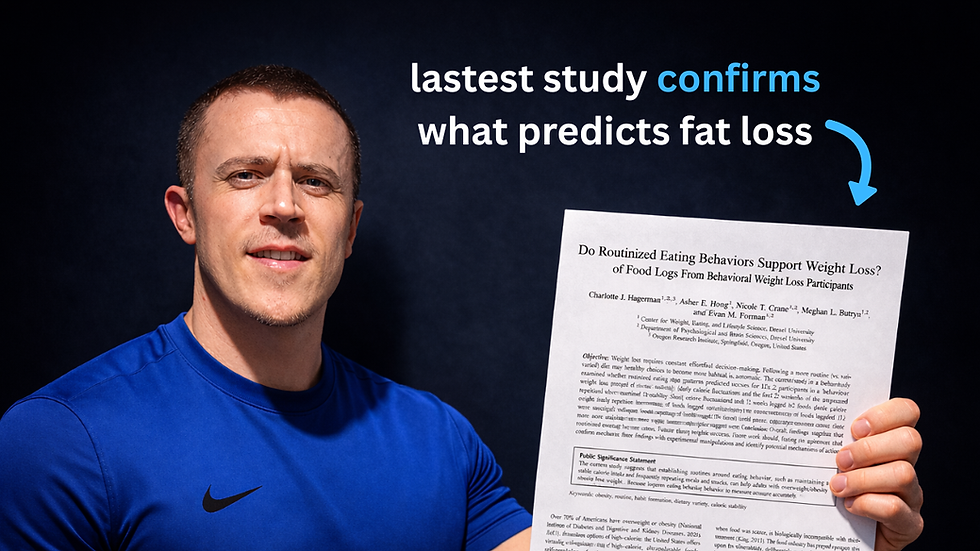
A recent weight loss study published in Health Psychology (American Psychological Association, 2026) explored a simple question:
Does eating the same meals every day improve fat loss results compared to a more varied diet?
The findings offer a clear insight.
Not just into what works, but why most people struggle to stay consistent.
And this insight may not only surprise you, but could also make your weight loss efforts easier and more predictable.
In this article, I will break down the study.
And give you a 5-Step Simplicity Framework to apply the findings to your weight loss journey.
Rather watch instead of read?
Watch The Full Breakdown Of The Study
What Does The Latest Fat Loss Research Say About Diet Consistency in 2026?
Researchers tracked 112 adults over a 12 week weight loss programme, analysing their eating habits in detail.
They focused on two key variables:
Calorie consistency (how stable intake was day to day)
Dietary repetition (how often people ate the same meals)
Key Finding: Meal Repetition Outperformed Variety
Participants who ate more repetitive meals lost 5.9% of their body weight, compared to 4.3% in those who ate a more varied diet.
Greater calorie stability was also linked to better results.
For every increase in calorie fluctuation, weight loss outcomes decreased.
Important Note On The Findings
This study shows a relationship, not direct cause and effect.
But it highlights something highly practical.
One thing I've learned over the last years as an online personal trainer in Ireland, and also as a psychotherapist, is this:
Making the right choice becomes much easier when you consciously give yourself fewer choices to make.
And the study findings reflect that lesson:
The more you reduce food decisions, the more consistent you become.
And consistency is what drives fat loss
Let's delve into this further, before we run through the 5-Step Simplicity Framework.
Why Is It So Hard To Stick To Weight Loss?
Most people don’t fail because they lack willpower.
They fail because their environment demands too many decisions.
Which often leads to something called decision fatigue.
What Is Decision Fatigue In Dieting?
Decision fatigue happens when your mental energy gets depleted from making too many choices.
For example:
You wake up early
You train
You shower and get dressed
You get the kids ready for school
You’re rushing out the door
Between training and the school run, you have a 15 minute window for breakfast.
And if you have to overthink it, instead of making a deliberate, pre-planned choice, you default to the easiest option
Not because you don’t care.
But because your brain is overloaded.
Does Eating The Same Meals Help You Lose Weight?
Based on both the research and my real-world coaching experience:
Yes, but not for the reason most people think.
It’s not that repetitive meals directly burn more fat.
It’s that they remove friction, and aid in making the right food choices more automatic.
Why Repetitive Eating Improves Fat Loss Adherence
When you eat similar meals:
You make fewer decisions
You reduce mental fatigue
You remove guesswork
You stay more consistent
And if you struggle with consistency, this article might help: How to stay consistent with weight loss
How To Structure Your Diet For Consistent Fat Loss
Instead of chasing variety, focus on simplicity.
Step 1: Build A Rotation Of Meals
Write down:
5 breakfast options
5 lunch options
5 dinner options
Make sure they are:
Easy to prepare
Enjoyable to eat
Aligned with your calorie and protein needs
Step 2: Chose One Idea For Each Meal
Choose one of your favourite and easiest-to-prepare ideas for breakfast, lunch and dinner, and eat that most days.
When you get tired of one (or all meals), go back to the list and select new ones.
Repeat the same process.
Step 3: Prepare Meals In Advance
When cooking one meal, prepare one or two for the next day.
For example, while making tonight's dinner, why not boil four eggs and make a bowl of overnight protein oats?
Before your dinner is done, breakfast and lunch will be ready for tomorrow.
This removes decision-making when you’re tired or busy.
Step 4: Use Your Rotation of Meals As A Grocery System
Instead of asking:
“What should I buy?”
Look back through rotation list of meals.
They become your shopping list.
Step 5: Keep Structure During The Week, Flexibility On Weekends
Follow a predictable structure Monday to Friday, aiming to keep your daily calories stable and consistent.
Then, allow flexibility on weekends.
This balance improves adherence without feeling restrictive
Is It Realistic To Lose 2 Stone Using This Approach?
Yes, but only when expectations align with reality.
If your goal is something like losing 2 stone in a sustainable way, structure becomes even more important.
I cover this in more detail in this article: 2 Stone Weight Loss: Here's How You Achieve It
This is where many people go wrong.
They set a goal, but:
Their expectations are unrealistic
Their actions are inconsistent
And that creates frustration.
This is something I break down in more detail here: Why do I keep failing with weight loss?
The Psychology Behind Why This Approach Works
This isn’t just about food.
It’s about psychology and behaviour.
When your diet is predictable:
You reduce cognitive load
You increase behavioural consistency
You build habits instead of relying on motivation
All of which has a positive impact on your mind, which, in turn, makes it easier to repeat the behaviours and establish the habits.
This ties directly into something I teach clients:
Alignment
When your goals, expectations, and actions align, progress feels natural
When they don’t, everything feels harder than it should
The Real Takeaway From This Study
The study doesn’t say:
“Eat the same meals and you’ll lose weight”
It shows something more useful:
Simplifying your diet makes it easier to stay consistent.
And consistency is what drives fat loss.
In a world full of food choices, complexity is the problem.
Simplicity is the solution.
Want Help Applying This In Real Life?
This is exactly what I help clients do. We don't just focus on what to eat.
But how to make it work in their actual life
You can learn more here:
Or if you want to get started straight away, you can apply for my 10 Day Reset Trial below.
Journal Reference
Charlotte J. Hagerman, Asher E. Hong, Nicole T. Crane, Meghan L. Butryn, Evan M. Forman. Do routinized eating behaviors support weight loss? An examination of food logs from behavioral weight loss participants. Health Psychology, 2026; DOI: 10.1037/hea0001591

About The Author
Coach Alan is a qualified ITEC Level 3 Personal Trainer with over 9 years of coaching experience, and the founder of Mind Body Training, where he works as an online personal trainer in Ireland to help clients achieve sustainable fat loss and long-term behaviour change. He is also a qualified Integrative Psychotherapist, having completed his four-year training with the Irish Institute of Counselling and Psychotherapy (IICP). His coaching approach is informed by evidence-based principles from psychology, nutrition, and exercise science, with a strong focus on mindful habit formation and realistic lifestyle change. You can learn more about Coach Alan here.
Mind Body Training provides coaching, education, and personal training services, not personal therapy or clinical counselling. Clients seeking therapeutic support are encouraged to work alongside a different qualified mental health professional where appropriate.

Comments